Ads used to be here |
 |
 |
 |
 |
 |
 |
 |
 |
|
An
Interview with
Zhang Yi Mou ("The Road Home," "Happy Times ", "Hero") |
|||||||||
|
|||||||||
|
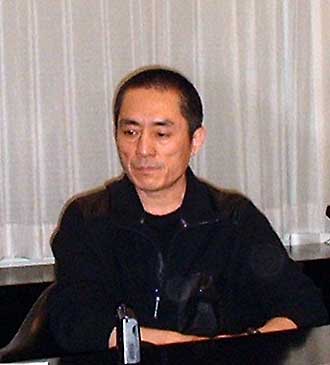
"Happy Times," is the second of acclaimed Chinese director Zhang Yimou's films to be set in a modern city. A departure from his previous films, "Happy Times" is a comedy touched with bitterness. The film revolves around an old man's plan to make money by refurbishing an old bus into the "Happy Times Hotel," a place where young couples can find privacy. Enter a blind, beautiful stepdaughter and the result is an intriguing and poignant look at life in modern China. Zhang Yimou recently visited New York to speak about his latest film, "Happy Times," his filmmaking style, and his upcoming martial arts epic, "Hero." AsianConnections' Sung-Un Choi and Gu Wei were there to interview the famous director.
I would like to try to make different types of films, different genres. For me that would be good training. For example, Happy Times is a realistic comedy with a touch of bitterness, and my next film is a martial arts film. From 1998 to the year 2000, I made three films, Not One Less, The Road Home, and Happy Times. I consider these three films a trilogy because they are all about commoners, little people. However, they all come with different styles. Not One Less is like a documentary. The Road Home is like a poetic essay while Happy Times is a comedy. So for me I'm satisfied with this trilogy, but it's time for me to move on. That's why I'm starting to make martial arts films and maybe I will make martial arts films for a little while. On being a filmmaker: Since I was 4, I was able to watch different types of films from various countries. Until today, going to the movies was my sole and most passionate habit. I didn't know what was a "born filmmaker." You have to watch a very simple work and model after them, learn after them to be a good filmmaker. So I can say I've been influenced by very many directors. On making Happy Times: It started with Chinese investments. Afterwards, it was purchased by the Americans. We had a project before. We were talking a long time but I was never satisfied with that script, so that project did not come true. But in the end, we put Happy Times together. On the idea of making a film in the United States: No. I never think about it. I don't speak English, I don't understand this society at all. I don't think I can make a good film here.
On his approach to Happy Times: The film was adapted from a novel, a story. What attracted me about the original story was the relationship between this old elderly worker and the abandoned bus, and how he renovated the bus into a motel to make money. I thought it was really absurd. However, it really reflected Chinese society. Everyone is busy and thinking about making more money. But by adding the fat step-mother and the blind girl switched the direction of the story to more about human relationships, about the sentiments among people. I think the film reflects my thinking of today's fast-changing society in China. Because it commercialized so fast, things change constantly. However, some things remain real. I suggest this truth and sincerity about people. On comparisons of his upcoming film Hero and Crouching Tiger, Hidden Dragon: Ang Lee is a friend of mine and I like Crouching Tiger very much. Making Hero, it's not trying to compete with Crouching Tiger. I think the success of Crouching Tiger is a miracle. It's almost impossible for me to hope that Hero will be as successful. But to be as successful as Crouching Tiger will be almost an accident - it's only something you can hope for. But for me to make such a big film, Hero, with a bigger investment [editor's note: Hero has a production budget of $30 million], I will hope the film will able to appeal to audiences around the world. Solely depending on the Chinese market, I will probably break even.
Also, as a filmmaker, I want to make a film that everyone can understand. And I feel that it's our responsibility to show the world the very lively culture of China. I would say Hero, will be as good as Crouching Tiger. About the state of Chinese cinema: The Chinese cinema is in a very difficult period for various reasons. We are experiencing a decrease in film-goers and a decrease in production. It has been a very popular subject for people to discuss, how to solve this situation. As a filmmaker, I cannot see myself resolving the problem. By the way to step up this situation, all I can say is, try to make the best film of each and every production, whether it's a big production or small production. And I think every filmmaker does their best to make the best film they can.
More on his approach to films: Very often we talk about how audience perceive our films, but whenever we talk about it, I can only think from the Chinese point of view. As a Chinese, there is no way to change the logic of my thinking. But for me, it's important to me to make a film that others can understand. Which means talking about the very sentiments among people. And the second is to keep your own character, and that's something that other people don't have. On the issue of why his films seem to have a female character as a central figure: As a filmmaker, you have to have a man and a woman. I have never made a film only about men or only about women. But to me, the tension between men and women, the love, it's always very important. For example, in Happy Times, although there is no romantic love, there is this care, some kind of sentiment like a father and daughter. And for my next film, it's a martial films, but besides all the elements of martial arts, there is also a very romantic love story. On how films reflect the times in which they were made: I think all the details in the film will reflect the spirits of a particular period of time. For example, when you look at films shot 20 years ago, through the details, you will experience the time, which is very natural. The period always leaves some mark in the film, and reflects the change of society or the political situation and about what people were thinking at that time. And I think this is the wonder of the film. For example, in Happy Times, what people are always concerned about in the film is money, which is impossible in a Chinese film 20 years ago because people would not be thinking about that. And that's how films can reflect the changing of the society. On censorship in China: The censorship has always been part of the film industry and it has not changed much throughout the years. It's become almost a permanent feature of the social structure today. The process is when - before the shooting begins - you have to send your script for them to review. And after they approve it, you can go out and shoot it. Then once you finish editing the film before the final cut, again, you have to send them your film to review again. And there's different stages you have to go through, first of all go through your province. Finally, the decision will be made from the central government, the film bureau. The process is called a back-to-back review system. There is a committee to review your films, but none of the filmmakers can participate in the process of reviewing. And then after that, you just wait for some time, they will send you a document to tell you the things that need to be changed. And this is the final result. Your only choice is to change accordingly. |
|||||||||
| AsianConnections wishes to thank Sony Pictures Classics, Zhang Yimou, and AC's Sung-Un Choi and Gu Wei for making this article possible. |



 On
his filmmaking style:
On
his filmmaking style:





 |
|||
|
 |
|
|
| | About Us | Disclaimers and Legal Information | Advertise With Us | We welcome your comments. Send e-mail to us at info@asianconnections.com Copyright ©1999-2002 AsianConnections.com |